La hidrodemolición aumenta la productividad en un proyecto de puente en Filipinas


Sea cual sea el proyecto -desde una simple estructura hasta un enorme sistema de puentes multimillonario-, una construcción eficiente requiere una planificación minuciosa. Pero, incluso con una logística impecable, los proyectos pueden tropezar con retos que pongan en peligro los plazos.


Actualmente se está construyendo en Filipinas un enorme sistema de puentes que conectará la ciudad de Cebú con Córdova, en el extremo sur de la isla de Mactán. La autopista de enlace Cebú-Córdova, de 8,5 kilómetros (5,3 millas) de longitud, cuya finalización está prevista para 2021, cruzará el canal de Mactán con un paso de navegación de 51 metros (167 patas) para los buques. Promete aliviar la congestión entre Cebú y Mactán e impulsar las actividades económicas en toda la región, proporcionando un acceso adicional a la isla y al Aeropuerto Internacional de Mactán-Cebú para unos 50.000 vehículos al día.

Como era de esperar, la construcción -uno de los mayores proyectos de infraestructuras del país- depende de un plan cuidadosamente coreografiado de operaciones simultáneas para cumplir plazos estrictos. Una logística experta permite a las cuadrillas evitar muchos obstáculos; sin embargo, aún pueden surgir retos imprevistos. Cuando un lote de hormigón de mala calidad amenazó con hacer descarrilar el progreso de uno de los primeros pilones del puente, los directores del proyecto necesitaban una solución creativa que pudiera retirar rápidamente el hormigón de mala calidad sin dañar el refuerzo ni retrasar el proyecto. La hidrodemolición era el único proceso con la precisión y productividad necesarias para mantener el proyecto en marcha.

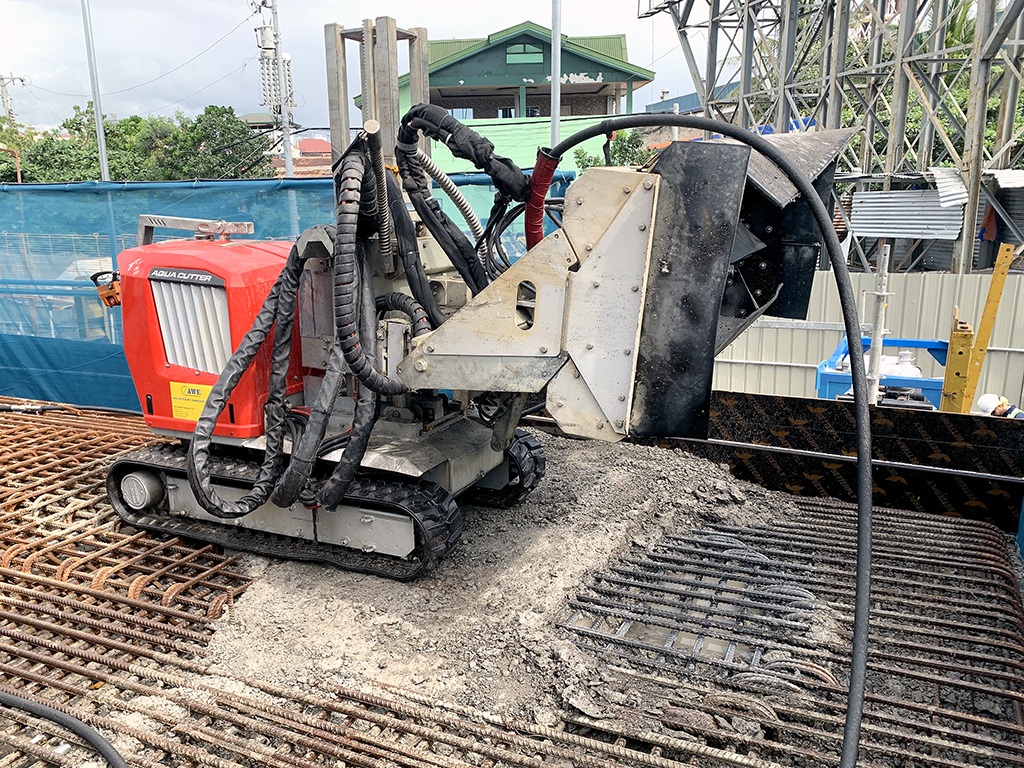
Cebu Link Joint Venture (CLJV) se puso en contacto con Asia Waterjet Equipment, con sede en Singapur, los principales expertos en hidrodemolición de la región. El acceso y las condiciones del lugar suponían todo un reto, pero con décadas de experiencia en algunas de las aplicaciones más peligrosas, Asia Waterjet Equipment estaba más que preparada para la tarea. Con el reloj en marcha y la temporada de monzones en pleno apogeo, el equipo llegó a la obra con un robot de hidrodemolición Aquajet Aqua Cutter 710V y una bomba de hidrodemolición Jetstream HP.
 

No matter the project — from a simple structure to a massive, multi-million-dollar bridge system — efficient construction requires thorough planning. But, even with flawless logistics, projects can run into challenges that put deadlines in jeopardy. Construction is currently underway in the Philippines on a massive bridge system connecting Cebu City with Cordova on the southern end of Mactan Island. The 8.5-kilometer (5.3-mile) Cebu-Cordova Link Expressway, slated for completion in 2021, will span the Mactan Channel with 51-meter (167-feet) navigational clearance for shipping vessels. It promises to ease congestion between Cebu and Mactan and boost economic activities throughout the region by providing additional access to the island and the Mactan-Cebu International Airport for an estimated 50,000 vehicles a day. As expected, the construction — one of the largest infrastructure projects in the country — relies on a carefully choreographed plan of simultaneous operations to meet strict deadlines. Expert logistics allow crews to avoid many hurdles; however, unforeseen challenges can still arise. When a bad batch of concrete threatened to derail progress on one of the bridge’s first pilons, project managers needed a creative solution that could quickly remove the poor-quality concrete without damaging the rebar or putting the project behind schedule. Hydrodemolition was the only process with the precision and productivity to keep the project on track. Cebu Link Joint Venture (CLJV) contacted Singapore-based Asia Waterjet Equipment, the region’s premier Hydrodemolition experts. Access and site conditions presented quite a challenge, but with decades of experience in some of the most hazardous applications, Asia Waterjet Equipment was more than up to the task. With the clock ticking and monsoon season in full swing, the team arrived onsite with an Aquajet Aqua Cutter 710V Hydrodemolition robot and Jetstream HP Waterjetting Pump. Passion for Problem Solving In the early 1990s, Asia Waterjet Equipment’s founders were part of the brave crews tasked with containing oil wells in Kuwait that were destroyed during the Persian Gulf War. Their experience helped avert a huge environmental crisis. They remained in the Middle East, eventually founding Asia Waterjet Equipment in 2006, bringing high-pressure water jetting and robotic Hydrodemolition to the Middle East and South East Asia. Now, with offices in Dubai, Abu Dhabi, Saudi Arabia, Bahrain and Singapore and a strong presence and partnerships throughout these territories, the company is known for creative problem solving — delivering innovative cutting and cleaning solutions for hazardous areas or difficult to pump products in petrochemical, wastewater, mining, construction and other industries. They also offer a range of robotic solutions to help customers protect employees and perform beyond expectations. “Our focus has always been providing the cutting-edge tools to make challenging applications safer and more efficient,” said Chris Parkhill, Asia Waterjet Equipment Sales Director for Southeast Asia. “From the very beginning, we’ve been involved in some of the most hazardous operations out there. We understand the demands and dangers, which is why we partner with industry-leading equipment manufacturers for robust solutions that maximize safety and productivity.” Pairing the right tools with experienced team members who bring a wealth of industry knowledge and a deep understanding of local markets to each project has earned Asia Waterjet Equipment a reputation for high-quality results. In emerging markets, such as the Philippines, where the demands of multi-million-dollar projects have become a proving ground for newer, more efficient technologies, this expertise puts the company at the forefront. “From North Africa to South East Asia, we cover a lot of ground,” Parkhill said. “But being able to meet the contractor where they are is key to a successful solution. Working with CLJV, there were a number of challenges we had to overcome to keep the project on track. Hydrodemolition was the best solution and Aquajet was the best tool for the job.” Troubled Water Access was the primary problem. CLJV was conducting construction on several bridge pilons simultaneously. To minimize disruptions to the local community, the project’s primary staging area, as well as the initial pilon, were only accessible from the coast. This meant the concrete had to be mixed 2.5 kilometers (1.6 miles) down the coast then transported by barge to the jobsite. From there, the barge was grounded, and the trucks disembarked directly onto the beach. The pilon was 30 meters (98 feet) inland. Overall, the transportation delay had no negative impacts on the concrete, and the 16-by-14-meter (52.5-by-45.9-foot) pilon quickly grew to 4 meters (13 feet) tall. However, a complication with a single delivery threatened to throw the entire project behind schedule and over budget. “When you are working with concrete, sometimes things don’t go to plan,” Parkhill said. “It’s a delicate equation, after all, and even a slight miscalculation can ruin the mixture. Unfortunately, when that happens, there isn’t an easy fix.” Crews knew there was a problem immediately. The concrete was already setting as they pumped. Vibrating and other correctional methods failed, and the pour was ultimately unsuccessful. Even worse, the concrete fell 350 millimeters (13.8 inches) short, leaving a mesh of exposed rebar. For CLJV and Asia Waterjet Equipment, the challenges were adding up, making for a very difficult repair. The pilon was nearly complete. While CLJV had budgeted time and money for small complications, it could not afford to demolish the whole pilon and start over. Crews with handheld breakers or excavators could remove the poor-quality concrete, but only by destroying the rebar. They would have to cut the exposed rebar at the top of the pilon to access the concrete a foot below. More rebar would be damaged as the poor-quality concrete was removed, and microfractures from the vibration of jackhammers or excavators would weaken the remaining concrete, jeopardizing the pilon’s integrity. “There was no option; the rebar and existing good concrete had to be protected,” Parkhill said. “If CLJV went with traditional demolition methods, they’d have to open, pry apart where possible or cut the rebar and manually jack hammer out the bad concrete. There’s no guarantee a man using a jack hammer could gauge what’s good and what’s bad, so they’d end up removing extra. Then they’d have to bend the rebar back into place without breaking it, or weld or cut new threads and join with it threaded couplers. It would add weeks to the project and a significant cost to the budget. They simply couldn’t afford it.” Asia Waterjet Equipment knew Hydrodemolition was the only solution. The non-intrusive method uses high-pressure water jets as powerful as 40,000 psi manipulated by an automated robot to remove layers of deteriorated and damaged concrete. The high-pressure water exceeds the strength of the concrete to widen existing pores and microcracks, breaking it apart in a controlled manner. Unlike other mechanical methods, Hydrodemolition is impact free, eliminating the vibrations that cause microfractures. Additionally, the method meets European Standards EN 1504 and provides a superior bonding surface for new concrete. The Aqua Cutter 710V’s high-pressure water jet leaves a rough, irregular profile after removing the initial layer of concrete that results in a better bonding strength. The robot also cleans and descales the exposed rebar and removes non-visible contaminants such as dirt, mud, foundation mud, salts, chlorides and sulfates. Building Bridges Productivity was also a concern. With simultaneous construction continuing on several other pilons in the area, crews needed to remove the poor-quality concrete and complete repairs quickly — with minimal labor. With the ability to complete concrete removal tasks up to 25 times faster than a hand lance, the Aqua Cutter provided the necessary solution to keep the project on schedule. Asia Waterjet Equipment brought in Aquajet Special Application Manager Kjell Isaksson to support the operation. “There were a lot of variables and no room for error,” Parkhill said. “To minimize the risk of delays, we decided it would be best to have an Aquajet specialist on site.” Like the cement trucks, the Aqua Cutter and all support equipment, including a high-pressure waterjet power pack with a 4200 series Jetstream pump, had to access the site from the Mactan Chanel. Proximity to the water and the frequent, heavy rains of monsoon season made ground conditions difficult. However, since the Aqua Cutter is self-propelled with tracks, the uneven, muddy terrain presented no problems for Asia Waterjet Equipment. This minimized necessary site preparations and helped accelerate repairs. Crossing the Bridge to Success This mobility was also necessary for tackling the demolition itself. Once lifted the 4 meters (13 feet) onto the pile cap by a crane, the Aqua Cutter was able to easily maneuver over the rebar. The high-pressure pump was setup 7 meters (23 feet) away and connected to the Hydrodemolition robot by a high-pressure hose. To help reduce cost and increase production, Asia Waterjet Equipment opted to use seawater for the majority of the demolition rather than bring in fresh water. The company continually filled two 20-cubic meter (5,283 gallon) night tanks directly from the Mactan Chanel. Fresh water was only used during the last two days of the project to remove salt and other impurities that could impact bonding. Using the Hydrodemolition robot, operating at 1,000 bar (15,000 psi), and two employees, Asia Waterjet Equipment removed 10 cubic meters (13 cubic yards) of poor-quality concrete at a depth of 150-250 millimeters (6-10 inches) in days. “With the Aquajet Aqua Cutter, we increased productivity to a point where construction was back on schedule,” Parkhill said. “Without Hydrodemolition, there’s no way CLJV would have been able to do that.” The Future of Hydrodemolition While construction on the bridge system continues, Asia Waterjet Equipment is already on to the next challenge. “Construction in Southeast Asia is changing,” Parkhill said. “Robotic processes like Hydrodemolition are proving you can have productivity and safety. With innovative partners like Aquajet, Asia Waterjet Equipment is playing a leading role in facilitating that change.”

Cuando un lote de hormigón de mala calidad amenazó con hacer descarrilar el progreso de un importante proyecto de puente en Filipinas, Asia Waterjet Equipment acudió a Aquajet en busca de una solución creativa que pudiera eliminar rápidamente el hormigón de mala calidad sin dañar el refuerzo ni retrasar el proyecto.


Pasión por la resolución de problemas

A principios de la década de 1990, los fundadores de Asia Waterjet Equipment formaron parte de los valientes equipos encargados de contener los pozos de petróleo de Kuwait destruidos durante la Guerra del Golfo Pérsico. Su experiencia ayudó a evitar una enorme crisis medioambiental. Permanecieron en Oriente Medio y acabaron fundando Asia Waterjet Equipment en 2006, llevando el water jetting a alta presión y la hidrodemolición robotizada a Oriente Medio y el Sudeste Asiático.

Ahora, con oficinas en Dubai, Abu Dhabi, Arabia Saudí, Bahréin y Singapur y una fuerte presencia y asociaciones en todos estos territorios, la empresa es conocida por resolver problemas de forma creativa, ofreciendo soluciones innovadoras de corte y limpieza para zonas peligrosas o productos difíciles de bombear en industrias petroquímicas, de aguas residuales, minería, construcción y otras. También ofrecen una gama de soluciones robóticas para ayudar a los clientes a proteger a sus empleados y superar sus expectativas.

“Nuestro objetivo siempre ha sido proporcionar las herramientas más avanzadas para que las aplicaciones más exigentes sean más seguras y eficientes”, afirma Chris Parkhill, Director de Ventas de Equipos de Chorro de Agua de Asia para el Sudeste Asiático. “Desde el principio, hemos participado en algunas de las operaciones más peligrosas que existen. Entendemos las exigencias y los peligros, por eso nos asociamos con fabricantes de equipos líderes del sector para obtener soluciones sólidas que maximicen la seguridad y la productividad.”

Combinar las herramientas adecuadas con miembros experimentados del equipo, que aportan a cada proyecto un amplio conocimiento del sector y una profunda comprensión de los mercados locales, ha dado a Asia Waterjet Equipment una reputación de resultados de alta calidad. En los mercados emergentes, como Filipinas, donde las exigencias de los proyectos multimillonarios se han convertido en un campo de pruebas para tecnologías más nuevas y eficientes, esta experiencia sitúa a la empresa a la vanguardia.

“Desde el norte de África hasta el sudeste asiático, cubrimos mucho terreno”, afirma Parkhill. “Pero ser capaz de encontrar al contratista donde está es clave para una solución satisfactoria. Al trabajar con CLJV, tuvimos que superar una serie de retos para mantener el proyecto en marcha. La hidrodemolición era la mejor solución y Aquajet la mejor herramienta para el trabajo”.


No matter the project — from a simple structure to a massive, multi-million-dollar bridge system — efficient construction requires thorough planning. But, even with flawless logistics, projects can run into challenges that put deadlines in jeopardy. Construction is currently underway in the Philippines on a massive bridge system connecting Cebu City with Cordova on the southern end of Mactan Island. The 8.5-kilometer (5.3-mile) Cebu-Cordova Link Expressway, slated for completion in 2021, will span the Mactan Channel with 51-meter (167-feet) navigational clearance for shipping vessels. It promises to ease congestion between Cebu and Mactan and boost economic activities throughout the region by providing additional access to the island and the Mactan-Cebu International Airport for an estimated 50,000 vehicles a day. As expected, the construction — one of the largest infrastructure projects in the country — relies on a carefully choreographed plan of simultaneous operations to meet strict deadlines. Expert logistics allow crews to avoid many hurdles; however, unforeseen challenges can still arise. When a bad batch of concrete threatened to derail progress on one of the bridge’s first pilons, project managers needed a creative solution that could quickly remove the poor-quality concrete without damaging the rebar or putting the project behind schedule. Hydrodemolition was the only process with the precision and productivity to keep the project on track. Cebu Link Joint Venture (CLJV) contacted Singapore-based Asia Waterjet Equipment, the region’s premier Hydrodemolition experts. Access and site conditions presented quite a challenge, but with decades of experience in some of the most hazardous applications, Asia Waterjet Equipment was more than up to the task. With the clock ticking and monsoon season in full swing, the team arrived onsite with an Aquajet Aqua Cutter 710V Hydrodemolition robot and Jetstream HP Waterjetting Pump. Passion for Problem Solving In the early 1990s, Asia Waterjet Equipment’s founders were part of the brave crews tasked with containing oil wells in Kuwait that were destroyed during the Persian Gulf War. Their experience helped avert a huge environmental crisis. They remained in the Middle East, eventually founding Asia Waterjet Equipment in 2006, bringing high-pressure water jetting and robotic Hydrodemolition to the Middle East and South East Asia. Now, with offices in Dubai, Abu Dhabi, Saudi Arabia, Bahrain and Singapore and a strong presence and partnerships throughout these territories, the company is known for creative problem solving — delivering innovative cutting and cleaning solutions for hazardous areas or difficult to pump products in petrochemical, wastewater, mining, construction and other industries. They also offer a range of robotic solutions to help customers protect employees and perform beyond expectations. “Our focus has always been providing the cutting-edge tools to make challenging applications safer and more efficient,” said Chris Parkhill, Asia Waterjet Equipment Sales Director for Southeast Asia. “From the very beginning, we’ve been involved in some of the most hazardous operations out there. We understand the demands and dangers, which is why we partner with industry-leading equipment manufacturers for robust solutions that maximize safety and productivity.” Pairing the right tools with experienced team members who bring a wealth of industry knowledge and a deep understanding of local markets to each project has earned Asia Waterjet Equipment a reputation for high-quality results. In emerging markets, such as the Philippines, where the demands of multi-million-dollar projects have become a proving ground for newer, more efficient technologies, this expertise puts the company at the forefront. “From North Africa to South East Asia, we cover a lot of ground,” Parkhill said. “But being able to meet the contractor where they are is key to a successful solution. Working with CLJV, there were a number of challenges we had to overcome to keep the project on track. Hydrodemolition was the best solution and Aquajet was the best tool for the job.” Troubled Water Access was the primary problem. CLJV was conducting construction on several bridge pilons simultaneously. To minimize disruptions to the local community, the project’s primary staging area, as well as the initial pilon, were only accessible from the coast. This meant the concrete had to be mixed 2.5 kilometers (1.6 miles) down the coast then transported by barge to the jobsite. From there, the barge was grounded, and the trucks disembarked directly onto the beach. The pilon was 30 meters (98 feet) inland. Overall, the transportation delay had no negative impacts on the concrete, and the 16-by-14-meter (52.5-by-45.9-foot) pilon quickly grew to 4 meters (13 feet) tall. However, a complication with a single delivery threatened to throw the entire project behind schedule and over budget. “When you are working with concrete, sometimes things don’t go to plan,” Parkhill said. “It’s a delicate equation, after all, and even a slight miscalculation can ruin the mixture. Unfortunately, when that happens, there isn’t an easy fix.” Crews knew there was a problem immediately. The concrete was already setting as they pumped. Vibrating and other correctional methods failed, and the pour was ultimately unsuccessful. Even worse, the concrete fell 350 millimeters (13.8 inches) short, leaving a mesh of exposed rebar. For CLJV and Asia Waterjet Equipment, the challenges were adding up, making for a very difficult repair. The pilon was nearly complete. While CLJV had budgeted time and money for small complications, it could not afford to demolish the whole pilon and start over. Crews with handheld breakers or excavators could remove the poor-quality concrete, but only by destroying the rebar. They would have to cut the exposed rebar at the top of the pilon to access the concrete a foot below. More rebar would be damaged as the poor-quality concrete was removed, and microfractures from the vibration of jackhammers or excavators would weaken the remaining concrete, jeopardizing the pilon’s integrity. “There was no option; the rebar and existing good concrete had to be protected,” Parkhill said. “If CLJV went with traditional demolition methods, they’d have to open, pry apart where possible or cut the rebar and manually jack hammer out the bad concrete. There’s no guarantee a man using a jack hammer could gauge what’s good and what’s bad, so they’d end up removing extra. Then they’d have to bend the rebar back into place without breaking it, or weld or cut new threads and join with it threaded couplers. It would add weeks to the project and a significant cost to the budget. They simply couldn’t afford it.” Asia Waterjet Equipment knew Hydrodemolition was the only solution. The non-intrusive method uses high-pressure water jets as powerful as 40,000 psi manipulated by an automated robot to remove layers of deteriorated and damaged concrete. The high-pressure water exceeds the strength of the concrete to widen existing pores and microcracks, breaking it apart in a controlled manner. Unlike other mechanical methods, Hydrodemolition is impact free, eliminating the vibrations that cause microfractures. Additionally, the method meets European Standards EN 1504 and provides a superior bonding surface for new concrete. The Aqua Cutter 710V’s high-pressure water jet leaves a rough, irregular profile after removing the initial layer of concrete that results in a better bonding strength. The robot also cleans and descales the exposed rebar and removes non-visible contaminants such as dirt, mud, foundation mud, salts, chlorides and sulfates. Building Bridges Productivity was also a concern. With simultaneous construction continuing on several other pilons in the area, crews needed to remove the poor-quality concrete and complete repairs quickly — with minimal labor. With the ability to complete concrete removal tasks up to 25 times faster than a hand lance, the Aqua Cutter provided the necessary solution to keep the project on schedule. Asia Waterjet Equipment brought in Aquajet Special Application Manager Kjell Isaksson to support the operation. “There were a lot of variables and no room for error,” Parkhill said. “To minimize the risk of delays, we decided it would be best to have an Aquajet specialist on site.” Like the cement trucks, the Aqua Cutter and all support equipment, including a high-pressure waterjet power pack with a 4200 series Jetstream pump, had to access the site from the Mactan Chanel. Proximity to the water and the frequent, heavy rains of monsoon season made ground conditions difficult. However, since the Aqua Cutter is self-propelled with tracks, the uneven, muddy terrain presented no problems for Asia Waterjet Equipment. This minimized necessary site preparations and helped accelerate repairs. Crossing the Bridge to Success This mobility was also necessary for tackling the demolition itself. Once lifted the 4 meters (13 feet) onto the pile cap by a crane, the Aqua Cutter was able to easily maneuver over the rebar. The high-pressure pump was setup 7 meters (23 feet) away and connected to the Hydrodemolition robot by a high-pressure hose. To help reduce cost and increase production, Asia Waterjet Equipment opted to use seawater for the majority of the demolition rather than bring in fresh water. The company continually filled two 20-cubic meter (5,283 gallon) night tanks directly from the Mactan Chanel. Fresh water was only used during the last two days of the project to remove salt and other impurities that could impact bonding. Using the Hydrodemolition robot, operating at 1,000 bar (15,000 psi), and two employees, Asia Waterjet Equipment removed 10 cubic meters (13 cubic yards) of poor-quality concrete at a depth of 150-250 millimeters (6-10 inches) in days. “With the Aquajet Aqua Cutter, we increased productivity to a point where construction was back on schedule,” Parkhill said. “Without Hydrodemolition, there’s no way CLJV would have been able to do that.” The Future of Hydrodemolition While construction on the bridge system continues, Asia Waterjet Equipment is already on to the next challenge. “Construction in Southeast Asia is changing,” Parkhill said. “Robotic processes like Hydrodemolition are proving you can have productivity and safety. With innovative partners like Aquajet, Asia Waterjet Equipment is playing a leading role in facilitating that change.”

Para proteger el refuerzo y el buen hormigón existente, Asia Waterjet Equipment sabía que la hidrodemolición era la única solución. Este método no intrusivo utiliza chorros de agua a alta presión de hasta 40.000 psi manipulados por un robot automatizado para eliminar capas de hormigón deteriorado y dañado.
 

No matter the project — from a simple structure to a massive, multi-million-dollar bridge system — efficient construction requires thorough planning. But, even with flawless logistics, projects can run into challenges that put deadlines in jeopardy. Construction is currently underway in the Philippines on a massive bridge system connecting Cebu City with Cordova on the southern end of Mactan Island. The 8.5-kilometer (5.3-mile) Cebu-Cordova Link Expressway, slated for completion in 2021, will span the Mactan Channel with 51-meter (167-feet) navigational clearance for shipping vessels. It promises to ease congestion between Cebu and Mactan and boost economic activities throughout the region by providing additional access to the island and the Mactan-Cebu International Airport for an estimated 50,000 vehicles a day. As expected, the construction — one of the largest infrastructure projects in the country — relies on a carefully choreographed plan of simultaneous operations to meet strict deadlines. Expert logistics allow crews to avoid many hurdles; however, unforeseen challenges can still arise. When a bad batch of concrete threatened to derail progress on one of the bridge’s first pilons, project managers needed a creative solution that could quickly remove the poor-quality concrete without damaging the rebar or putting the project behind schedule. Hydrodemolition was the only process with the precision and productivity to keep the project on track. Cebu Link Joint Venture (CLJV) contacted Singapore-based Asia Waterjet Equipment, the region’s premier Hydrodemolition experts. Access and site conditions presented quite a challenge, but with decades of experience in some of the most hazardous applications, Asia Waterjet Equipment was more than up to the task. With the clock ticking and monsoon season in full swing, the team arrived onsite with an Aquajet Aqua Cutter 710V Hydrodemolition robot and Jetstream HP Waterjetting Pump. Passion for Problem Solving In the early 1990s, Asia Waterjet Equipment’s founders were part of the brave crews tasked with containing oil wells in Kuwait that were destroyed during the Persian Gulf War. Their experience helped avert a huge environmental crisis. They remained in the Middle East, eventually founding Asia Waterjet Equipment in 2006, bringing high-pressure water jetting and robotic Hydrodemolition to the Middle East and South East Asia. Now, with offices in Dubai, Abu Dhabi, Saudi Arabia, Bahrain and Singapore and a strong presence and partnerships throughout these territories, the company is known for creative problem solving — delivering innovative cutting and cleaning solutions for hazardous areas or difficult to pump products in petrochemical, wastewater, mining, construction and other industries. They also offer a range of robotic solutions to help customers protect employees and perform beyond expectations. “Our focus has always been providing the cutting-edge tools to make challenging applications safer and more efficient,” said Chris Parkhill, Asia Waterjet Equipment Sales Director for Southeast Asia. “From the very beginning, we’ve been involved in some of the most hazardous operations out there. We understand the demands and dangers, which is why we partner with industry-leading equipment manufacturers for robust solutions that maximize safety and productivity.” Pairing the right tools with experienced team members who bring a wealth of industry knowledge and a deep understanding of local markets to each project has earned Asia Waterjet Equipment a reputation for high-quality results. In emerging markets, such as the Philippines, where the demands of multi-million-dollar projects have become a proving ground for newer, more efficient technologies, this expertise puts the company at the forefront. “From North Africa to South East Asia, we cover a lot of ground,” Parkhill said. “But being able to meet the contractor where they are is key to a successful solution. Working with CLJV, there were a number of challenges we had to overcome to keep the project on track. Hydrodemolition was the best solution and Aquajet was the best tool for the job.” Troubled Water Access was the primary problem. CLJV was conducting construction on several bridge pilons simultaneously. To minimize disruptions to the local community, the project’s primary staging area, as well as the initial pilon, were only accessible from the coast. This meant the concrete had to be mixed 2.5 kilometers (1.6 miles) down the coast then transported by barge to the jobsite. From there, the barge was grounded, and the trucks disembarked directly onto the beach. The pilon was 30 meters (98 feet) inland. Overall, the transportation delay had no negative impacts on the concrete, and the 16-by-14-meter (52.5-by-45.9-foot) pilon quickly grew to 4 meters (13 feet) tall. However, a complication with a single delivery threatened to throw the entire project behind schedule and over budget. “When you are working with concrete, sometimes things don’t go to plan,” Parkhill said. “It’s a delicate equation, after all, and even a slight miscalculation can ruin the mixture. Unfortunately, when that happens, there isn’t an easy fix.” Crews knew there was a problem immediately. The concrete was already setting as they pumped. Vibrating and other correctional methods failed, and the pour was ultimately unsuccessful. Even worse, the concrete fell 350 millimeters (13.8 inches) short, leaving a mesh of exposed rebar. For CLJV and Asia Waterjet Equipment, the challenges were adding up, making for a very difficult repair. The pilon was nearly complete. While CLJV had budgeted time and money for small complications, it could not afford to demolish the whole pilon and start over. Crews with handheld breakers or excavators could remove the poor-quality concrete, but only by destroying the rebar. They would have to cut the exposed rebar at the top of the pilon to access the concrete a foot below. More rebar would be damaged as the poor-quality concrete was removed, and microfractures from the vibration of jackhammers or excavators would weaken the remaining concrete, jeopardizing the pilon’s integrity. “There was no option; the rebar and existing good concrete had to be protected,” Parkhill said. “If CLJV went with traditional demolition methods, they’d have to open, pry apart where possible or cut the rebar and manually jack hammer out the bad concrete. There’s no guarantee a man using a jack hammer could gauge what’s good and what’s bad, so they’d end up removing extra. Then they’d have to bend the rebar back into place without breaking it, or weld or cut new threads and join with it threaded couplers. It would add weeks to the project and a significant cost to the budget. They simply couldn’t afford it.” Asia Waterjet Equipment knew Hydrodemolition was the only solution. The non-intrusive method uses high-pressure water jets as powerful as 40,000 psi manipulated by an automated robot to remove layers of deteriorated and damaged concrete. The high-pressure water exceeds the strength of the concrete to widen existing pores and microcracks, breaking it apart in a controlled manner. Unlike other mechanical methods, Hydrodemolition is impact free, eliminating the vibrations that cause microfractures. Additionally, the method meets European Standards EN 1504 and provides a superior bonding surface for new concrete. The Aqua Cutter 710V’s high-pressure water jet leaves a rough, irregular profile after removing the initial layer of concrete that results in a better bonding strength. The robot also cleans and descales the exposed rebar and removes non-visible contaminants such as dirt, mud, foundation mud, salts, chlorides and sulfates. Building Bridges Productivity was also a concern. With simultaneous construction continuing on several other pilons in the area, crews needed to remove the poor-quality concrete and complete repairs quickly — with minimal labor. With the ability to complete concrete removal tasks up to 25 times faster than a hand lance, the Aqua Cutter provided the necessary solution to keep the project on schedule. Asia Waterjet Equipment brought in Aquajet Special Application Manager Kjell Isaksson to support the operation. “There were a lot of variables and no room for error,” Parkhill said. “To minimize the risk of delays, we decided it would be best to have an Aquajet specialist on site.” Like the cement trucks, the Aqua Cutter and all support equipment, including a high-pressure waterjet power pack with a 4200 series Jetstream pump, had to access the site from the Mactan Chanel. Proximity to the water and the frequent, heavy rains of monsoon season made ground conditions difficult. However, since the Aqua Cutter is self-propelled with tracks, the uneven, muddy terrain presented no problems for Asia Waterjet Equipment. This minimized necessary site preparations and helped accelerate repairs. Crossing the Bridge to Success This mobility was also necessary for tackling the demolition itself. Once lifted the 4 meters (13 feet) onto the pile cap by a crane, the Aqua Cutter was able to easily maneuver over the rebar. The high-pressure pump was setup 7 meters (23 feet) away and connected to the Hydrodemolition robot by a high-pressure hose. To help reduce cost and increase production, Asia Waterjet Equipment opted to use seawater for the majority of the demolition rather than bring in fresh water. The company continually filled two 20-cubic meter (5,283 gallon) night tanks directly from the Mactan Chanel. Fresh water was only used during the last two days of the project to remove salt and other impurities that could impact bonding. Using the Hydrodemolition robot, operating at 1,000 bar (15,000 psi), and two employees, Asia Waterjet Equipment removed 10 cubic meters (13 cubic yards) of poor-quality concrete at a depth of 150-250 millimeters (6-10 inches) in days. “With the Aquajet Aqua Cutter, we increased productivity to a point where construction was back on schedule,” Parkhill said. “Without Hydrodemolition, there’s no way CLJV would have been able to do that.” The Future of Hydrodemolition While construction on the bridge system continues, Asia Waterjet Equipment is already on to the next challenge. “Construction in Southeast Asia is changing,” Parkhill said. “Robotic processes like Hydrodemolition are proving you can have productivity and safety. With innovative partners like Aquajet, Asia Waterjet Equipment is playing a leading role in facilitating that change.”

Los equipos con martillos manuales o excavadoras podían retirar el hormigón de mala calidad, pero sólo destruyendo el refuerzo. Asia Waterjet Equipment sabía que la hidrodemolición era el único proceso con la precisión y productividad necesarias para mantener el proyecto en marcha.


Aguas turbulentas

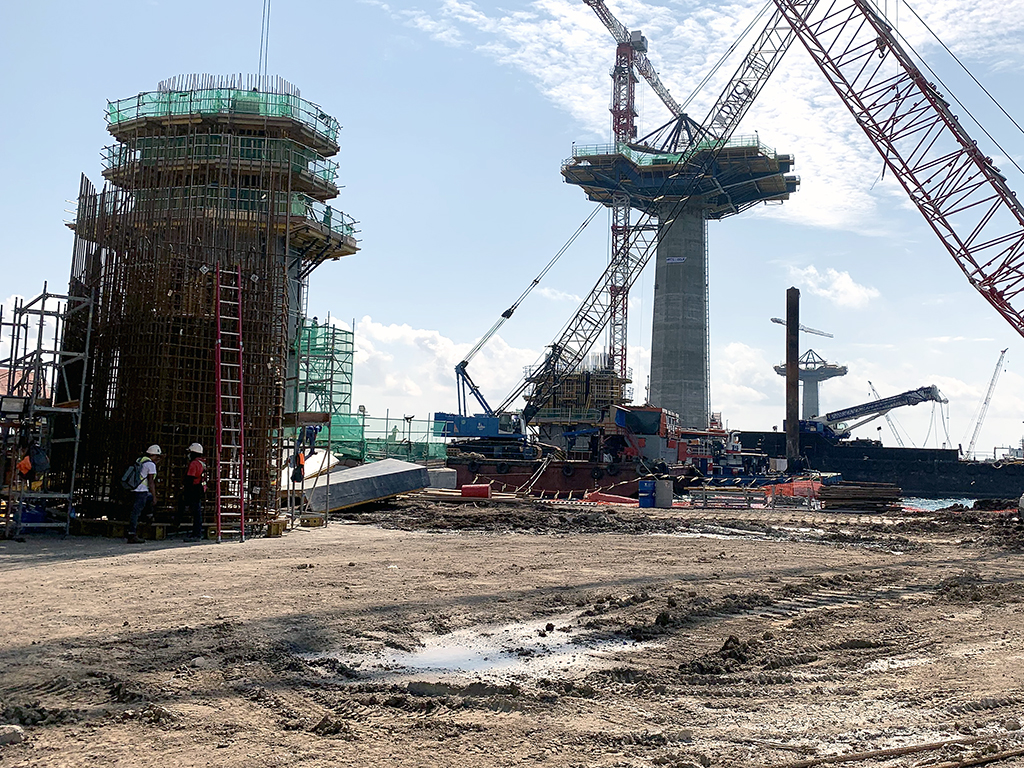
El acceso era el principal problema. El CLJV estaba llevando a cabo la construcción de varios pilones de puente simultáneamente. Para minimizar las molestias a la comunidad local, la principal zona de montaje del proyecto, así como el pilón inicial, sólo eran accesibles desde la costa. Esto significaba que el hormigón tenía que mezclarse a 2,5 kilómetros (1,6 millas) de la costa y luego transportarse en barcaza a la obra. Desde allí, la barcaza se encallaba y los camiones desembarcaban directamente en la playa. El pilón estaba a 30 metros (98 patas) tierra adentro.

En general, el retraso del transporte no tuvo efectos negativos en el hormigón, y el pilón de 16 por 14 metros (52,5 por 45,9 patas) creció rápidamente hasta los 4 metros (13 patas) de altura. Sin embargo, una complicación con una sola entrega amenazó con retrasar todo el proyecto y sobrepasar el presupuesto.

“Cuando trabajas con hormigón, a veces las cosas no salen según lo previsto”, dijo Parkhill. “Al fin y al cabo, es una ecuación delicada, e incluso un ligero error de cálculo puede arruinar la mezcla. Por desgracia, cuando eso ocurre, no hay una solución fácil”.

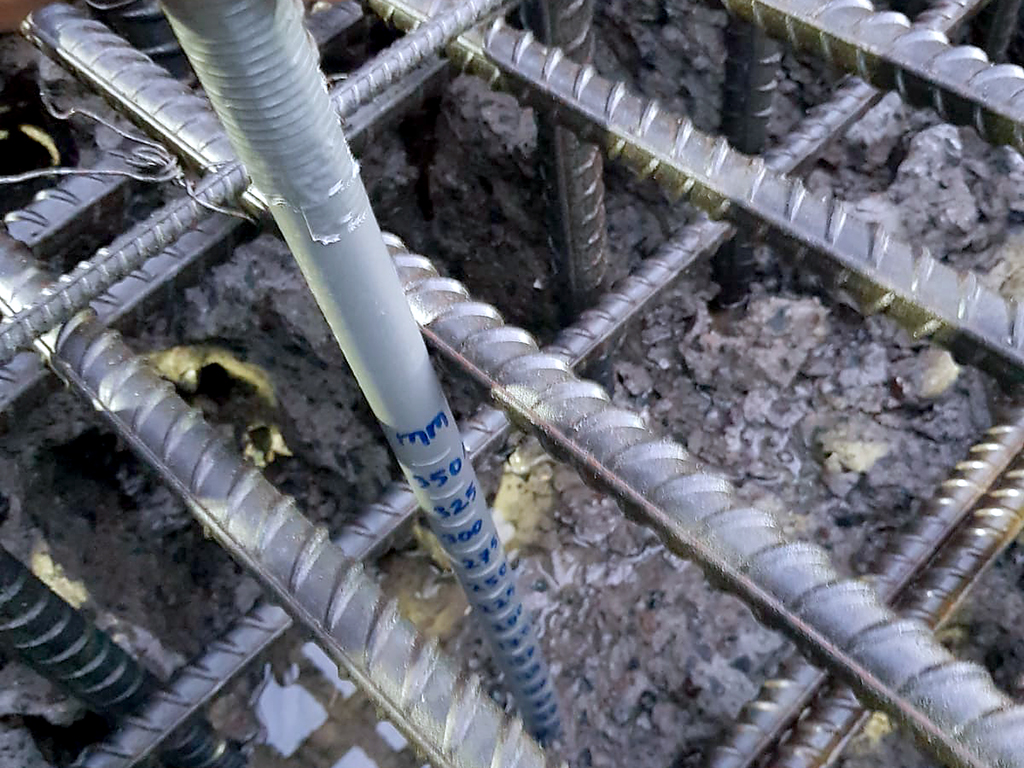
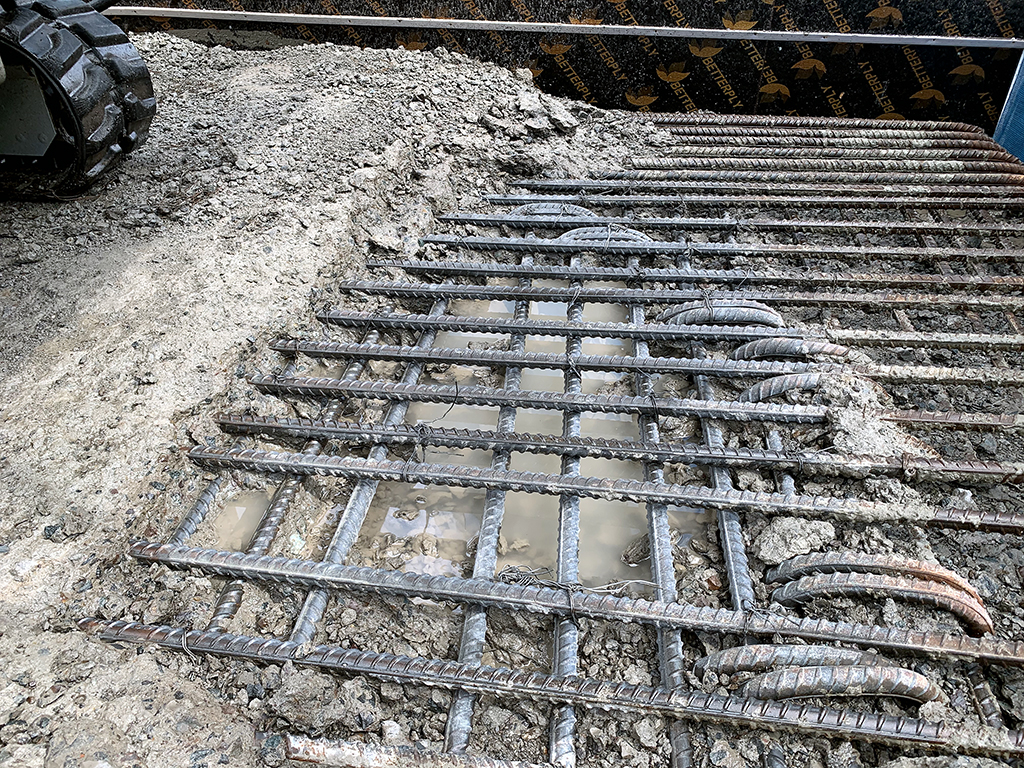
Los equipos supieron inmediatamente que había un problema. El hormigón ya estaba fraguando mientras bombeaban. La vibración y otros métodos de corrección fallaron, y el vertido resultó finalmente infructuoso. Peor aún, el hormigón se quedó corto 350 milímetros (13,8 pulgadas), dejando una malla de refuerzo expuesta.

Para CLJV y Asia Waterjet Equipment, los retos se iban acumulando, haciendo que la reparación fuera muy difícil. El pilón estaba casi completo. Aunque CLJV había presupuestado tiempo y dinero para pequeñas complicaciones, no podía permitirse demoler toda la pilona y empezar de nuevo.

Los equipos con martillos de mano o excavadoras podrían retirar el hormigón de mala calidad, pero sólo destruyendo las barras de refuerzo. Tendrían que cortar las barras de refuerzo expuestas en la parte superior del pilón para acceder al hormigón que hay un pie por debajo. Se dañarían más barras de refuerzo al retirar el hormigón de mala calidad, y las microfracturas provocadas por la vibración de los martillos neumáticos o las excavadoras debilitarían el hormigón restante, poniendo en peligro la integridad del pilón.

“No había otra opción: había que proteger las barras de refuerzo y el hormigón en buen estado”, dijo Parkhill. “Si el CLJV utilizara métodos de demolición tradicionales, tendría que abrir, hacer palanca donde fuera posible o cortar el refuerzo y extraer manualmente con un martillo neumático el hormigón en mal estado. No hay garantía de que un hombre con un martillo neumático pueda calibrar lo que está bien y lo que está mal, así que acabarían quitando de más. Luego tendrían que volver a doblar el refuerzo en su sitio sin romperlo, o soldar o cortar nuevas roscas y unirlas con acopladores roscados. Añadiría semanas al proyecto y un coste significativo al presupuesto. Sencillamente, no podían permitírselo”.

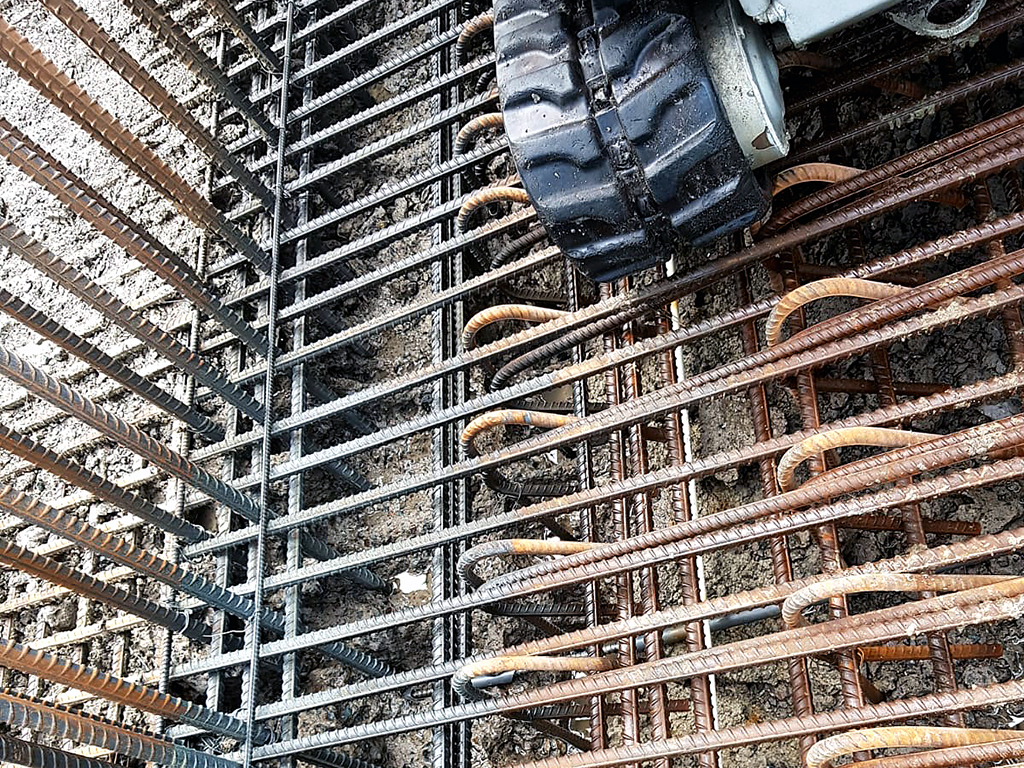
Asia Waterjet Equipment sabía que la hidrodemolición era la única solución. Este método no intrusivo utiliza chorros de agua a alta presión de hasta 40.000 psi manipulados por un robot automatizado para eliminar capas de hormigón deteriorado y dañado. El agua a alta presión supera la resistencia del hormigón para ensanchar los poros y microfisuras existentes, rompiéndolo de forma controlada. A diferencia de otros métodos mecánicos, la hidrodemolición no produce impactos, eliminando las vibraciones que causan microfracturas.

Además, el método cumple la Normativa Europea EN 1504 y proporciona una superficie de adherencia superior para el hormigón nuevo. El chorro de agua a alta presión del Aqua Cutter 710V deja un perfil rugoso e irregular tras eliminar la capa inicial de hormigón, lo que se traduce en una mayor fuerza de adherencia. El robot también limpia y desincrusta el refuerzo expuesto y elimina contaminantes no visibles como suciedad, barro, lodo de cimentación, sales, cloruros y sulfatos.
 

No matter the project — from a simple structure to a massive, multi-million-dollar bridge system — efficient construction requires thorough planning. But, even with flawless logistics, projects can run into challenges that put deadlines in jeopardy. Construction is currently underway in the Philippines on a massive bridge system connecting Cebu City with Cordova on the southern end of Mactan Island. The 8.5-kilometer (5.3-mile) Cebu-Cordova Link Expressway, slated for completion in 2021, will span the Mactan Channel with 51-meter (167-feet) navigational clearance for shipping vessels. It promises to ease congestion between Cebu and Mactan and boost economic activities throughout the region by providing additional access to the island and the Mactan-Cebu International Airport for an estimated 50,000 vehicles a day. As expected, the construction — one of the largest infrastructure projects in the country — relies on a carefully choreographed plan of simultaneous operations to meet strict deadlines. Expert logistics allow crews to avoid many hurdles; however, unforeseen challenges can still arise. When a bad batch of concrete threatened to derail progress on one of the bridge’s first pilons, project managers needed a creative solution that could quickly remove the poor-quality concrete without damaging the rebar or putting the project behind schedule. Hydrodemolition was the only process with the precision and productivity to keep the project on track. Cebu Link Joint Venture (CLJV) contacted Singapore-based Asia Waterjet Equipment, the region’s premier Hydrodemolition experts. Access and site conditions presented quite a challenge, but with decades of experience in some of the most hazardous applications, Asia Waterjet Equipment was more than up to the task. With the clock ticking and monsoon season in full swing, the team arrived onsite with an Aquajet Aqua Cutter 710V Hydrodemolition robot and Jetstream HP Waterjetting Pump. Passion for Problem Solving In the early 1990s, Asia Waterjet Equipment’s founders were part of the brave crews tasked with containing oil wells in Kuwait that were destroyed during the Persian Gulf War. Their experience helped avert a huge environmental crisis. They remained in the Middle East, eventually founding Asia Waterjet Equipment in 2006, bringing high-pressure water jetting and robotic Hydrodemolition to the Middle East and South East Asia. Now, with offices in Dubai, Abu Dhabi, Saudi Arabia, Bahrain and Singapore and a strong presence and partnerships throughout these territories, the company is known for creative problem solving — delivering innovative cutting and cleaning solutions for hazardous areas or difficult to pump products in petrochemical, wastewater, mining, construction and other industries. They also offer a range of robotic solutions to help customers protect employees and perform beyond expectations. “Our focus has always been providing the cutting-edge tools to make challenging applications safer and more efficient,” said Chris Parkhill, Asia Waterjet Equipment Sales Director for Southeast Asia. “From the very beginning, we’ve been involved in some of the most hazardous operations out there. We understand the demands and dangers, which is why we partner with industry-leading equipment manufacturers for robust solutions that maximize safety and productivity.” Pairing the right tools with experienced team members who bring a wealth of industry knowledge and a deep understanding of local markets to each project has earned Asia Waterjet Equipment a reputation for high-quality results. In emerging markets, such as the Philippines, where the demands of multi-million-dollar projects have become a proving ground for newer, more efficient technologies, this expertise puts the company at the forefront. “From North Africa to South East Asia, we cover a lot of ground,” Parkhill said. “But being able to meet the contractor where they are is key to a successful solution. Working with CLJV, there were a number of challenges we had to overcome to keep the project on track. Hydrodemolition was the best solution and Aquajet was the best tool for the job.” Troubled Water Access was the primary problem. CLJV was conducting construction on several bridge pilons simultaneously. To minimize disruptions to the local community, the project’s primary staging area, as well as the initial pilon, were only accessible from the coast. This meant the concrete had to be mixed 2.5 kilometers (1.6 miles) down the coast then transported by barge to the jobsite. From there, the barge was grounded, and the trucks disembarked directly onto the beach. The pilon was 30 meters (98 feet) inland. Overall, the transportation delay had no negative impacts on the concrete, and the 16-by-14-meter (52.5-by-45.9-foot) pilon quickly grew to 4 meters (13 feet) tall. However, a complication with a single delivery threatened to throw the entire project behind schedule and over budget. “When you are working with concrete, sometimes things don’t go to plan,” Parkhill said. “It’s a delicate equation, after all, and even a slight miscalculation can ruin the mixture. Unfortunately, when that happens, there isn’t an easy fix.” Crews knew there was a problem immediately. The concrete was already setting as they pumped. Vibrating and other correctional methods failed, and the pour was ultimately unsuccessful. Even worse, the concrete fell 350 millimeters (13.8 inches) short, leaving a mesh of exposed rebar. For CLJV and Asia Waterjet Equipment, the challenges were adding up, making for a very difficult repair. The pilon was nearly complete. While CLJV had budgeted time and money for small complications, it could not afford to demolish the whole pilon and start over. Crews with handheld breakers or excavators could remove the poor-quality concrete, but only by destroying the rebar. They would have to cut the exposed rebar at the top of the pilon to access the concrete a foot below. More rebar would be damaged as the poor-quality concrete was removed, and microfractures from the vibration of jackhammers or excavators would weaken the remaining concrete, jeopardizing the pilon’s integrity. “There was no option; the rebar and existing good concrete had to be protected,” Parkhill said. “If CLJV went with traditional demolition methods, they’d have to open, pry apart where possible or cut the rebar and manually jack hammer out the bad concrete. There’s no guarantee a man using a jack hammer could gauge what’s good and what’s bad, so they’d end up removing extra. Then they’d have to bend the rebar back into place without breaking it, or weld or cut new threads and join with it threaded couplers. It would add weeks to the project and a significant cost to the budget. They simply couldn’t afford it.” Asia Waterjet Equipment knew Hydrodemolition was the only solution. The non-intrusive method uses high-pressure water jets as powerful as 40,000 psi manipulated by an automated robot to remove layers of deteriorated and damaged concrete. The high-pressure water exceeds the strength of the concrete to widen existing pores and microcracks, breaking it apart in a controlled manner. Unlike other mechanical methods, Hydrodemolition is impact free, eliminating the vibrations that cause microfractures. Additionally, the method meets European Standards EN 1504 and provides a superior bonding surface for new concrete. The Aqua Cutter 710V’s high-pressure water jet leaves a rough, irregular profile after removing the initial layer of concrete that results in a better bonding strength. The robot also cleans and descales the exposed rebar and removes non-visible contaminants such as dirt, mud, foundation mud, salts, chlorides and sulfates. Building Bridges Productivity was also a concern. With simultaneous construction continuing on several other pilons in the area, crews needed to remove the poor-quality concrete and complete repairs quickly — with minimal labor. With the ability to complete concrete removal tasks up to 25 times faster than a hand lance, the Aqua Cutter provided the necessary solution to keep the project on schedule. Asia Waterjet Equipment brought in Aquajet Special Application Manager Kjell Isaksson to support the operation. “There were a lot of variables and no room for error,” Parkhill said. “To minimize the risk of delays, we decided it would be best to have an Aquajet specialist on site.” Like the cement trucks, the Aqua Cutter and all support equipment, including a high-pressure waterjet power pack with a 4200 series Jetstream pump, had to access the site from the Mactan Chanel. Proximity to the water and the frequent, heavy rains of monsoon season made ground conditions difficult. However, since the Aqua Cutter is self-propelled with tracks, the uneven, muddy terrain presented no problems for Asia Waterjet Equipment. This minimized necessary site preparations and helped accelerate repairs. Crossing the Bridge to Success This mobility was also necessary for tackling the demolition itself. Once lifted the 4 meters (13 feet) onto the pile cap by a crane, the Aqua Cutter was able to easily maneuver over the rebar. The high-pressure pump was setup 7 meters (23 feet) away and connected to the Hydrodemolition robot by a high-pressure hose. To help reduce cost and increase production, Asia Waterjet Equipment opted to use seawater for the majority of the demolition rather than bring in fresh water. The company continually filled two 20-cubic meter (5,283 gallon) night tanks directly from the Mactan Chanel. Fresh water was only used during the last two days of the project to remove salt and other impurities that could impact bonding. Using the Hydrodemolition robot, operating at 1,000 bar (15,000 psi), and two employees, Asia Waterjet Equipment removed 10 cubic meters (13 cubic yards) of poor-quality concrete at a depth of 150-250 millimeters (6-10 inches) in days. “With the Aquajet Aqua Cutter, we increased productivity to a point where construction was back on schedule,” Parkhill said. “Without Hydrodemolition, there’s no way CLJV would have been able to do that.” The Future of Hydrodemolition While construction on the bridge system continues, Asia Waterjet Equipment is already on to the next challenge. “Construction in Southeast Asia is changing,” Parkhill said. “Robotic processes like Hydrodemolition are proving you can have productivity and safety. With innovative partners like Aquajet, Asia Waterjet Equipment is playing a leading role in facilitating that change.”

Con capacidad para completar tareas de eliminación de hormigón hasta 25 veces más rápido que una lanza manual, el Aqua Cutter de Aquajet proporcionó la solución necesaria para mantener el proyecto de Asia Waterjet Equipment dentro del plazo previsto.


Construir puentes

La productividad también era un problema. Con la construcción simultánea de otros pilones en la zona, las cuadrillas tenían que retirar el hormigón de mala calidad y terminar las reparaciones rápidamente, con la mínima mano de obra.

Gracias a su capacidad para realizar tareas de eliminación de hormigón hasta 25 veces más rápido que con una lanza manual, el Aqua Cutter proporcionó la solución necesaria para mantener el proyecto dentro del plazo previsto. Asia Waterjet Equipment contrató al Director de Aplicaciones Especiales de Aquajet, Kjell Isaksson, para apoyar la operación.

“Había muchas variables y ningún margen de error”, dijo Parkhill. “Para minimizar el riesgo de retrasos, decidimos que lo mejor sería contar con un especialista de Aquajet in situ”.

Al igual que los camiones hormigonera, el Aqua Cutter y todo el equipo de apoyo, incluida una unidad motriz de chorro de agua a alta presión con una bomba Jetstream de la serie 4200, tuvieron que acceder a la obra desde el Chanel de Mactan. La proximidad al agua y las frecuentes y fuertes lluvias de la estación monzónica dificultaban las condiciones del terreno. Sin embargo, dado que la Aqua Cutter es autopropulsada con orugas, el terreno irregular y embarrado no supuso ningún problema para Asia Waterjet Equipment. Esto minimizó los preparativos necesarios en el lugar y ayudó a acelerar las reparaciones.
 

No matter the project — from a simple structure to a massive, multi-million-dollar bridge system — efficient construction requires thorough planning. But, even with flawless logistics, projects can run into challenges that put deadlines in jeopardy. Construction is currently underway in the Philippines on a massive bridge system connecting Cebu City with Cordova on the southern end of Mactan Island. The 8.5-kilometer (5.3-mile) Cebu-Cordova Link Expressway, slated for completion in 2021, will span the Mactan Channel with 51-meter (167-feet) navigational clearance for shipping vessels. It promises to ease congestion between Cebu and Mactan and boost economic activities throughout the region by providing additional access to the island and the Mactan-Cebu International Airport for an estimated 50,000 vehicles a day. As expected, the construction — one of the largest infrastructure projects in the country — relies on a carefully choreographed plan of simultaneous operations to meet strict deadlines. Expert logistics allow crews to avoid many hurdles; however, unforeseen challenges can still arise. When a bad batch of concrete threatened to derail progress on one of the bridge’s first pilons, project managers needed a creative solution that could quickly remove the poor-quality concrete without damaging the rebar or putting the project behind schedule. Hydrodemolition was the only process with the precision and productivity to keep the project on track. Cebu Link Joint Venture (CLJV) contacted Singapore-based Asia Waterjet Equipment, the region’s premier Hydrodemolition experts. Access and site conditions presented quite a challenge, but with decades of experience in some of the most hazardous applications, Asia Waterjet Equipment was more than up to the task. With the clock ticking and monsoon season in full swing, the team arrived onsite with an Aquajet Aqua Cutter 710V Hydrodemolition robot and Jetstream HP Waterjetting Pump. Passion for Problem Solving In the early 1990s, Asia Waterjet Equipment’s founders were part of the brave crews tasked with containing oil wells in Kuwait that were destroyed during the Persian Gulf War. Their experience helped avert a huge environmental crisis. They remained in the Middle East, eventually founding Asia Waterjet Equipment in 2006, bringing high-pressure water jetting and robotic Hydrodemolition to the Middle East and South East Asia. Now, with offices in Dubai, Abu Dhabi, Saudi Arabia, Bahrain and Singapore and a strong presence and partnerships throughout these territories, the company is known for creative problem solving — delivering innovative cutting and cleaning solutions for hazardous areas or difficult to pump products in petrochemical, wastewater, mining, construction and other industries. They also offer a range of robotic solutions to help customers protect employees and perform beyond expectations. “Our focus has always been providing the cutting-edge tools to make challenging applications safer and more efficient,” said Chris Parkhill, Asia Waterjet Equipment Sales Director for Southeast Asia. “From the very beginning, we’ve been involved in some of the most hazardous operations out there. We understand the demands and dangers, which is why we partner with industry-leading equipment manufacturers for robust solutions that maximize safety and productivity.” Pairing the right tools with experienced team members who bring a wealth of industry knowledge and a deep understanding of local markets to each project has earned Asia Waterjet Equipment a reputation for high-quality results. In emerging markets, such as the Philippines, where the demands of multi-million-dollar projects have become a proving ground for newer, more efficient technologies, this expertise puts the company at the forefront. “From North Africa to South East Asia, we cover a lot of ground,” Parkhill said. “But being able to meet the contractor where they are is key to a successful solution. Working with CLJV, there were a number of challenges we had to overcome to keep the project on track. Hydrodemolition was the best solution and Aquajet was the best tool for the job.” Troubled Water Access was the primary problem. CLJV was conducting construction on several bridge pilons simultaneously. To minimize disruptions to the local community, the project’s primary staging area, as well as the initial pilon, were only accessible from the coast. This meant the concrete had to be mixed 2.5 kilometers (1.6 miles) down the coast then transported by barge to the jobsite. From there, the barge was grounded, and the trucks disembarked directly onto the beach. The pilon was 30 meters (98 feet) inland. Overall, the transportation delay had no negative impacts on the concrete, and the 16-by-14-meter (52.5-by-45.9-foot) pilon quickly grew to 4 meters (13 feet) tall. However, a complication with a single delivery threatened to throw the entire project behind schedule and over budget. “When you are working with concrete, sometimes things don’t go to plan,” Parkhill said. “It’s a delicate equation, after all, and even a slight miscalculation can ruin the mixture. Unfortunately, when that happens, there isn’t an easy fix.” Crews knew there was a problem immediately. The concrete was already setting as they pumped. Vibrating and other correctional methods failed, and the pour was ultimately unsuccessful. Even worse, the concrete fell 350 millimeters (13.8 inches) short, leaving a mesh of exposed rebar. For CLJV and Asia Waterjet Equipment, the challenges were adding up, making for a very difficult repair. The pilon was nearly complete. While CLJV had budgeted time and money for small complications, it could not afford to demolish the whole pilon and start over. Crews with handheld breakers or excavators could remove the poor-quality concrete, but only by destroying the rebar. They would have to cut the exposed rebar at the top of the pilon to access the concrete a foot below. More rebar would be damaged as the poor-quality concrete was removed, and microfractures from the vibration of jackhammers or excavators would weaken the remaining concrete, jeopardizing the pilon’s integrity. “There was no option; the rebar and existing good concrete had to be protected,” Parkhill said. “If CLJV went with traditional demolition methods, they’d have to open, pry apart where possible or cut the rebar and manually jack hammer out the bad concrete. There’s no guarantee a man using a jack hammer could gauge what’s good and what’s bad, so they’d end up removing extra. Then they’d have to bend the rebar back into place without breaking it, or weld or cut new threads and join with it threaded couplers. It would add weeks to the project and a significant cost to the budget. They simply couldn’t afford it.” Asia Waterjet Equipment knew Hydrodemolition was the only solution. The non-intrusive method uses high-pressure water jets as powerful as 40,000 psi manipulated by an automated robot to remove layers of deteriorated and damaged concrete. The high-pressure water exceeds the strength of the concrete to widen existing pores and microcracks, breaking it apart in a controlled manner. Unlike other mechanical methods, Hydrodemolition is impact free, eliminating the vibrations that cause microfractures. Additionally, the method meets European Standards EN 1504 and provides a superior bonding surface for new concrete. The Aqua Cutter 710V’s high-pressure water jet leaves a rough, irregular profile after removing the initial layer of concrete that results in a better bonding strength. The robot also cleans and descales the exposed rebar and removes non-visible contaminants such as dirt, mud, foundation mud, salts, chlorides and sulfates. Building Bridges Productivity was also a concern. With simultaneous construction continuing on several other pilons in the area, crews needed to remove the poor-quality concrete and complete repairs quickly — with minimal labor. With the ability to complete concrete removal tasks up to 25 times faster than a hand lance, the Aqua Cutter provided the necessary solution to keep the project on schedule. Asia Waterjet Equipment brought in Aquajet Special Application Manager Kjell Isaksson to support the operation. “There were a lot of variables and no room for error,” Parkhill said. “To minimize the risk of delays, we decided it would be best to have an Aquajet specialist on site.” Like the cement trucks, the Aqua Cutter and all support equipment, including a high-pressure waterjet power pack with a 4200 series Jetstream pump, had to access the site from the Mactan Chanel. Proximity to the water and the frequent, heavy rains of monsoon season made ground conditions difficult. However, since the Aqua Cutter is self-propelled with tracks, the uneven, muddy terrain presented no problems for Asia Waterjet Equipment. This minimized necessary site preparations and helped accelerate repairs. Crossing the Bridge to Success This mobility was also necessary for tackling the demolition itself. Once lifted the 4 meters (13 feet) onto the pile cap by a crane, the Aqua Cutter was able to easily maneuver over the rebar. The high-pressure pump was setup 7 meters (23 feet) away and connected to the Hydrodemolition robot by a high-pressure hose. To help reduce cost and increase production, Asia Waterjet Equipment opted to use seawater for the majority of the demolition rather than bring in fresh water. The company continually filled two 20-cubic meter (5,283 gallon) night tanks directly from the Mactan Chanel. Fresh water was only used during the last two days of the project to remove salt and other impurities that could impact bonding. Using the Hydrodemolition robot, operating at 1,000 bar (15,000 psi), and two employees, Asia Waterjet Equipment removed 10 cubic meters (13 cubic yards) of poor-quality concrete at a depth of 150-250 millimeters (6-10 inches) in days. “With the Aquajet Aqua Cutter, we increased productivity to a point where construction was back on schedule,” Parkhill said. “Without Hydrodemolition, there’s no way CLJV would have been able to do that.” The Future of Hydrodemolition While construction on the bridge system continues, Asia Waterjet Equipment is already on to the next challenge. “Construction in Southeast Asia is changing,” Parkhill said. “Robotic processes like Hydrodemolition are proving you can have productivity and safety. With innovative partners like Aquajet, Asia Waterjet Equipment is playing a leading role in facilitating that change.”

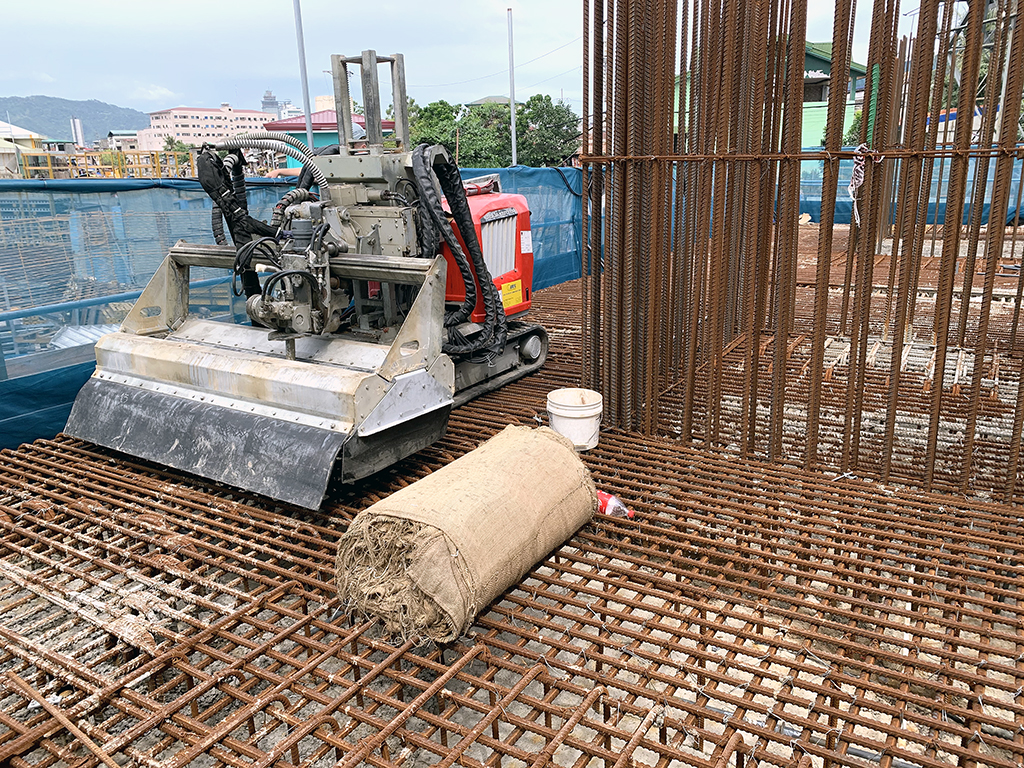
El terreno irregular y fangoso del lugar de trabajo no supuso ningún problema para la Aqua Cutter autopropulsada. Esto minimizó los preparativos necesarios en el lugar y ayudó a acelerar las reparaciones.

Cruzar el puente hacia el éxito

Esta movilidad también era necesaria para abordar la demolición propiamente dicha. Una vez elevado los 4 metros (13 patas) sobre el encepado por una grúa, el Aqua Cutter pudo maniobrar fácilmente sobre el refuerzo. La bomba de alta presión se instaló a 7 metros de distancia y se conectó al robot de hidrodemolición mediante una manguera de alta presión.

Para reducir costes y aumentar la producción, Asia Waterjet Equipment optó por utilizar agua de mar para la mayor parte de la demolición en lugar de traer agua dulce. La empresa llenó continuamente dos depósitos nocturnos de 20 metros cúbicos (5.283 galones) directamente desde el Canal de Mactan. Sólo se utilizó agua dulce durante los dos últimos días del proyecto para eliminar la sal y otras impurezas que pudieran afectar a la adherencia.

Utilizando el robot de hidrodemolición, que funciona a 1.000 bares (15.000 psi), y dos empleados, Asia Waterjet Equipment eliminó en días 10 metros cúbicos (13 yardas cúbicas) de hormigón de mala calidad a una profundidad de 150-250 milímetros (6-10 pulgadas).

“Con el Aqua Cutter de Aquajet, aumentamos la productividad hasta el punto de que la construcción volvió a estar dentro de plazo”, dijo Parkhill. “Sin la hidrodemolición, es imposible que CLJV hubiera podido hacerlo”.


No matter the project — from a simple structure to a massive, multi-million-dollar bridge system — efficient construction requires thorough planning. But, even with flawless logistics, projects can run into challenges that put deadlines in jeopardy. Construction is currently underway in the Philippines on a massive bridge system connecting Cebu City with Cordova on the southern end of Mactan Island. The 8.5-kilometer (5.3-mile) Cebu-Cordova Link Expressway, slated for completion in 2021, will span the Mactan Channel with 51-meter (167-feet) navigational clearance for shipping vessels. It promises to ease congestion between Cebu and Mactan and boost economic activities throughout the region by providing additional access to the island and the Mactan-Cebu International Airport for an estimated 50,000 vehicles a day. As expected, the construction — one of the largest infrastructure projects in the country — relies on a carefully choreographed plan of simultaneous operations to meet strict deadlines. Expert logistics allow crews to avoid many hurdles; however, unforeseen challenges can still arise. When a bad batch of concrete threatened to derail progress on one of the bridge’s first pilons, project managers needed a creative solution that could quickly remove the poor-quality concrete without damaging the rebar or putting the project behind schedule. Hydrodemolition was the only process with the precision and productivity to keep the project on track. Cebu Link Joint Venture (CLJV) contacted Singapore-based Asia Waterjet Equipment, the region’s premier Hydrodemolition experts. Access and site conditions presented quite a challenge, but with decades of experience in some of the most hazardous applications, Asia Waterjet Equipment was more than up to the task. With the clock ticking and monsoon season in full swing, the team arrived onsite with an Aquajet Aqua Cutter 710V Hydrodemolition robot and Jetstream HP Waterjetting Pump. Passion for Problem Solving In the early 1990s, Asia Waterjet Equipment’s founders were part of the brave crews tasked with containing oil wells in Kuwait that were destroyed during the Persian Gulf War. Their experience helped avert a huge environmental crisis. They remained in the Middle East, eventually founding Asia Waterjet Equipment in 2006, bringing high-pressure water jetting and robotic Hydrodemolition to the Middle East and South East Asia. Now, with offices in Dubai, Abu Dhabi, Saudi Arabia, Bahrain and Singapore and a strong presence and partnerships throughout these territories, the company is known for creative problem solving — delivering innovative cutting and cleaning solutions for hazardous areas or difficult to pump products in petrochemical, wastewater, mining, construction and other industries. They also offer a range of robotic solutions to help customers protect employees and perform beyond expectations. “Our focus has always been providing the cutting-edge tools to make challenging applications safer and more efficient,” said Chris Parkhill, Asia Waterjet Equipment Sales Director for Southeast Asia. “From the very beginning, we’ve been involved in some of the most hazardous operations out there. We understand the demands and dangers, which is why we partner with industry-leading equipment manufacturers for robust solutions that maximize safety and productivity.” Pairing the right tools with experienced team members who bring a wealth of industry knowledge and a deep understanding of local markets to each project has earned Asia Waterjet Equipment a reputation for high-quality results. In emerging markets, such as the Philippines, where the demands of multi-million-dollar projects have become a proving ground for newer, more efficient technologies, this expertise puts the company at the forefront. “From North Africa to South East Asia, we cover a lot of ground,” Parkhill said. “But being able to meet the contractor where they are is key to a successful solution. Working with CLJV, there were a number of challenges we had to overcome to keep the project on track. Hydrodemolition was the best solution and Aquajet was the best tool for the job.” Troubled Water Access was the primary problem. CLJV was conducting construction on several bridge pilons simultaneously. To minimize disruptions to the local community, the project’s primary staging area, as well as the initial pilon, were only accessible from the coast. This meant the concrete had to be mixed 2.5 kilometers (1.6 miles) down the coast then transported by barge to the jobsite. From there, the barge was grounded, and the trucks disembarked directly onto the beach. The pilon was 30 meters (98 feet) inland. Overall, the transportation delay had no negative impacts on the concrete, and the 16-by-14-meter (52.5-by-45.9-foot) pilon quickly grew to 4 meters (13 feet) tall. However, a complication with a single delivery threatened to throw the entire project behind schedule and over budget. “When you are working with concrete, sometimes things don’t go to plan,” Parkhill said. “It’s a delicate equation, after all, and even a slight miscalculation can ruin the mixture. Unfortunately, when that happens, there isn’t an easy fix.” Crews knew there was a problem immediately. The concrete was already setting as they pumped. Vibrating and other correctional methods failed, and the pour was ultimately unsuccessful. Even worse, the concrete fell 350 millimeters (13.8 inches) short, leaving a mesh of exposed rebar. For CLJV and Asia Waterjet Equipment, the challenges were adding up, making for a very difficult repair. The pilon was nearly complete. While CLJV had budgeted time and money for small complications, it could not afford to demolish the whole pilon and start over. Crews with handheld breakers or excavators could remove the poor-quality concrete, but only by destroying the rebar. They would have to cut the exposed rebar at the top of the pilon to access the concrete a foot below. More rebar would be damaged as the poor-quality concrete was removed, and microfractures from the vibration of jackhammers or excavators would weaken the remaining concrete, jeopardizing the pilon’s integrity. “There was no option; the rebar and existing good concrete had to be protected,” Parkhill said. “If CLJV went with traditional demolition methods, they’d have to open, pry apart where possible or cut the rebar and manually jack hammer out the bad concrete. There’s no guarantee a man using a jack hammer could gauge what’s good and what’s bad, so they’d end up removing extra. Then they’d have to bend the rebar back into place without breaking it, or weld or cut new threads and join with it threaded couplers. It would add weeks to the project and a significant cost to the budget. They simply couldn’t afford it.” Asia Waterjet Equipment knew Hydrodemolition was the only solution. The non-intrusive method uses high-pressure water jets as powerful as 40,000 psi manipulated by an automated robot to remove layers of deteriorated and damaged concrete. The high-pressure water exceeds the strength of the concrete to widen existing pores and microcracks, breaking it apart in a controlled manner. Unlike other mechanical methods, Hydrodemolition is impact free, eliminating the vibrations that cause microfractures. Additionally, the method meets European Standards EN 1504 and provides a superior bonding surface for new concrete. The Aqua Cutter 710V’s high-pressure water jet leaves a rough, irregular profile after removing the initial layer of concrete that results in a better bonding strength. The robot also cleans and descales the exposed rebar and removes non-visible contaminants such as dirt, mud, foundation mud, salts, chlorides and sulfates. Building Bridges Productivity was also a concern. With simultaneous construction continuing on several other pilons in the area, crews needed to remove the poor-quality concrete and complete repairs quickly — with minimal labor. With the ability to complete concrete removal tasks up to 25 times faster than a hand lance, the Aqua Cutter provided the necessary solution to keep the project on schedule. Asia Waterjet Equipment brought in Aquajet Special Application Manager Kjell Isaksson to support the operation. “There were a lot of variables and no room for error,” Parkhill said. “To minimize the risk of delays, we decided it would be best to have an Aquajet specialist on site.” Like the cement trucks, the Aqua Cutter and all support equipment, including a high-pressure waterjet power pack with a 4200 series Jetstream pump, had to access the site from the Mactan Chanel. Proximity to the water and the frequent, heavy rains of monsoon season made ground conditions difficult. However, since the Aqua Cutter is self-propelled with tracks, the uneven, muddy terrain presented no problems for Asia Waterjet Equipment. This minimized necessary site preparations and helped accelerate repairs. Crossing the Bridge to Success This mobility was also necessary for tackling the demolition itself. Once lifted the 4 meters (13 feet) onto the pile cap by a crane, the Aqua Cutter was able to easily maneuver over the rebar. The high-pressure pump was setup 7 meters (23 feet) away and connected to the Hydrodemolition robot by a high-pressure hose. To help reduce cost and increase production, Asia Waterjet Equipment opted to use seawater for the majority of the demolition rather than bring in fresh water. The company continually filled two 20-cubic meter (5,283 gallon) night tanks directly from the Mactan Chanel. Fresh water was only used during the last two days of the project to remove salt and other impurities that could impact bonding. Using the Hydrodemolition robot, operating at 1,000 bar (15,000 psi), and two employees, Asia Waterjet Equipment removed 10 cubic meters (13 cubic yards) of poor-quality concrete at a depth of 150-250 millimeters (6-10 inches) in days. “With the Aquajet Aqua Cutter, we increased productivity to a point where construction was back on schedule,” Parkhill said. “Without Hydrodemolition, there’s no way CLJV would have been able to do that.” The Future of Hydrodemolition While construction on the bridge system continues, Asia Waterjet Equipment is already on to the next challenge. “Construction in Southeast Asia is changing,” Parkhill said. “Robotic processes like Hydrodemolition are proving you can have productivity and safety. With innovative partners like Aquajet, Asia Waterjet Equipment is playing a leading role in facilitating that change.”

Utilizando el robot de hidrodemolición, que funciona a 1.000 bares (15.000 psi), y dos empleados, Asia Waterjet Equipment retiró 10 metros cúbicos (13 yardas cúbicas) de hormigón de mala calidad a una profundidad de 150-250 milímetros (6-10 pulgadas).


El futuro de la hidrodemolición

Mientras continúa la construcción del sistema de puentes, Asia Waterjet Equipment ya está en el siguiente reto.

“La construcción en el Sudeste Asiático está cambiando”, afirma Parkhill. “Los procesos robotizados como la hidrodemolición están demostrando que se puede tener productividad y seguridad. Con socios innovadores como Aquajet, Asia Waterjet Equipment está desempeñando un papel destacado a la hora de facilitar ese cambio.”


Hechos breves

Ubicación:
Un enorme sistema de puentes que conecta la ciudad de Cebú con Córdoba, en el extremo sur de la isla de Mactán, en Filipinas.

Proyecto de puente:
La autopista de enlace Cebú-Córdova, de 8,5 km de longitud y cuya finalización está prevista para 2021, cruzará el canal de Mactan con un paso de navegación de 51 metros para los buques.

Proyecto de hidrodemolición:
Eliminación selectiva de hormigón de mala calidad sin dañar el refuerzo ni retrasar el proyecto.

Material demolido:
10 metros cúbicos (13 yardas cúbicas) de hormigón de mala calidad a una profundidad de 150-250 milímetros (6-10 pulgadas).

Equipamiento: Aqua Cutter 710V.


Más información

Aqua Cutter 710V

Hidrodemolición

Red mundial de distribuidores Aquajet


PDF imprimible

Aquajet In situ – La innovadora solución robótica de Aquajet aporta productividad al proyecto de un puente en Filipinas